















The busiest airports of 2025 across global, international and European markets
-
Travel
-
-
3 mins
-
Travel Daily News
-
Tatiana Rokou
-


Capacity data for 2025 highlights the world’s busiest airports across global, international and European rankings, reflecting strong recovery patterns, shifting hubs and continued growth in key aviation markets.
Airline capacity data for 2025 by OAG confirms that the world’s busiest airports remain concentrated in regions with large domestic markets and strong hub connectivity. North America and Asia dominate the global rankings, alongside major hubs in Europe and the Middle East.

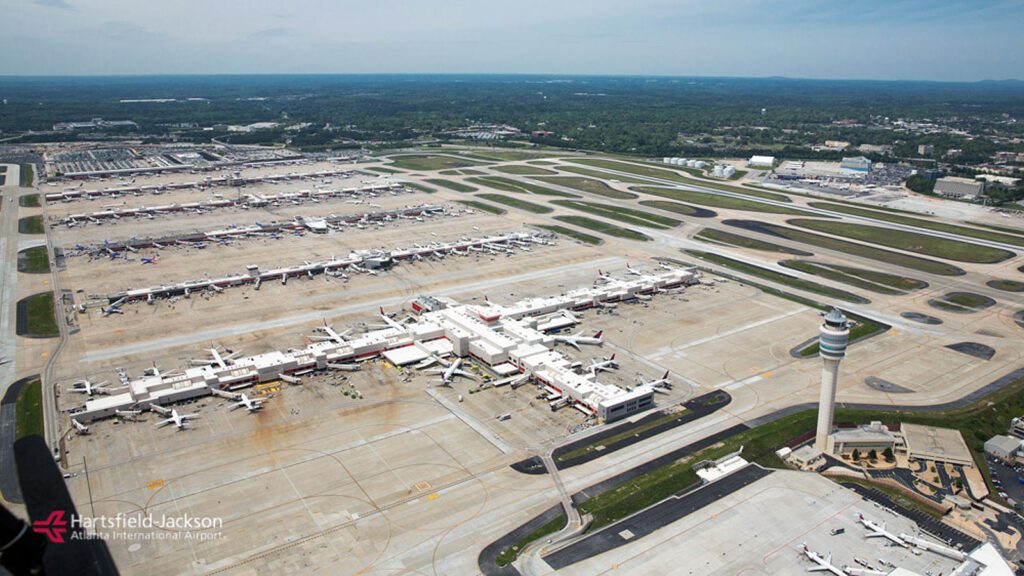
Atlanta Hartsfield-Jackson International Airport retained its position as the world’s busiest airport in 2025 with 63.1 million seats. Capacity increased by 1% compared to 2024 and stood just 221,207 seats below 2019 levels, indicating a near-complete recovery.
Dubai International Airport ranked second globally with 62.4 million seats. Although it exceeded Atlanta’s monthly volumes during parts of the year, it remained marginally behind on an annual basis. Dubai’s capacity was 4% higher year-on-year and 16% above 2019 levels, positioning it as a strong contender for the top ranking in the coming years.
Tokyo Haneda Airport placed third with 55.4 million seats, showing stable performance year-on-year and remaining 1% above 2019 capacity. Chicago O’Hare and Istanbul Airport recorded the strongest annual growth among the global top ten, with capacity rising by 8% and 6% respectively. Chicago returned to its 2019 capacity level, while Istanbul exceeded its pre-pandemic volume by 22%.

Denver International Airport delivered the largest long-term growth among the top ten airports, with capacity 24% above 2019 levels, although year-on-year growth in 2025 was limited to 1%.
Compared with 2019, the global top ten in 2025 included four new entrants. Istanbul Airport ranked fifth in 2025, up from 16th in 2019. Dallas Fort Worth International Airport moved to sixth place from 13th. Guangzhou Baiyun Airport ranked ninth, compared with 12th in 2019, while Denver International Airport entered the top ten in tenth position, up from 21st.
In the international-only ranking based on total international seat capacity, Dubai International Airport remained the world’s busiest international airport in 2025 with 62.4 million seats. Capacity increased by 4% year-on-year and was 16% above 2019 levels. Dubai offered 13.5 million more international seats than the second-ranked airport.
London Heathrow Airport ranked second internationally with 49.0 million seats, reflecting a 1% increase versus 2024 and capacity 4% above 2019. Seoul Incheon International Airport held third place with 43.0 million seats, growing by 3% year-on-year and reaching 2% above pre-pandemic levels.
Singapore Changi Airport followed closely with 42.6 million seats, a 3% annual increase, bringing capacity back in line with 2019. Istanbul Airport recorded one of the strongest international growth rates, reaching 41.2 million international seats, up 7% from 2024 and 27% above 2019.

Hong Kong International Airport showed the largest year-on-year growth among the international top ten, rising by 12% to 38.7 million seats. Despite this recovery, capacity remained 14% below 2019. Frankfurt Airport ranked ninth with 36.4 million seats, 2% higher than 2024 but still 8% behind pre-pandemic levels. Doha completed the top ten with 32.7 million seats, up 1% year-on-year and 20% above 2019.
Within Europe, London Heathrow Airport remained the busiest airport in 2025 with 52.1 million seats, representing a 1% increase compared to 2024 and capacity 4% above 2019. Istanbul Airport followed closely in second place with 51.5 million seats and strong annual growth of 6%.
Istanbul Airport also recorded the largest long-term expansion in the European top ten, with total capacity 22% higher than in 2019. Paris Charles de Gaulle Airport ranked third with 43.2 million seats, up 3% year-on-year but still 4% below pre-pandemic capacity.
Also read → Air travel statistics 2025: Key milestones shaping aviation in 2026
Istanbul Sabiha Gökçen Airport posted the strongest year-on-year growth among Europe’s top ten, increasing capacity by 15% to 28.6 million seats. It also recorded the fastest long-term growth, with capacity 37% above 2019 levels.
Frankfurt and Munich airports remained the furthest below pre-pandemic capacity among the European top ten, at 10% and 12% respectively below 2019. Both, however, continued to recover, recording year-on-year growth of 3% and 5% in 2025.
The article The busiest airports of 2025 across global, international and European markets first appeared in TravelDailyNews International.
The post The busiest airports of 2025 across global, international and European markets appeared first on Travel Daily News